Where Is the Water Shut Off Valve Under the Kitchen Sink in a Lewisburg Home?
Knowing where these two small valves sit, and how to close them gently, turns a wet cabinet into a calm five-minute fix.
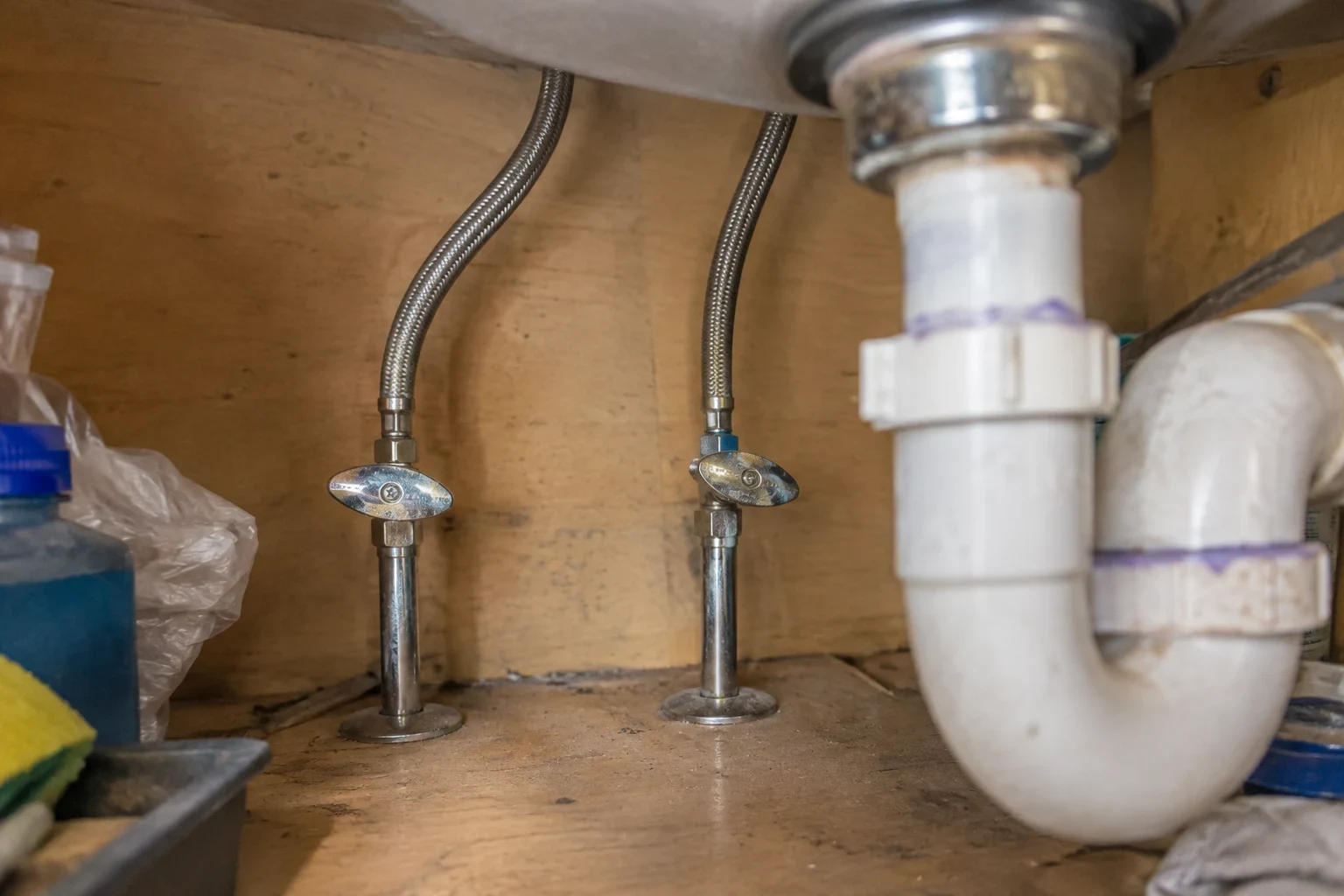
Where is the water shut off valve under the kitchen sink?
The kitchen sink shutoff valves sit inside the sink cabinet, on the two supply lines that feed the faucet, either coming out of the back wall or up through the cabinet floor. Hot is usually on the left and cold on the right. Turn each handle clockwise until it stops to cut water to the faucet.
What the valves look like and where to look
Open both cabinet doors and clear out the cleaning bottles first. You are looking for two small chrome or brass fittings, each with an oval or lever handle, sitting a few inches below the sink basin. A braided steel or plastic supply hose runs from the top of each valve up to the underside of the faucet.
Where they sit depends on how your home was built. Houses on a slab usually have the pipes coming straight out of the back wall. Many older homes around Lewisburg sit over a crawlspace, so the pipes rise through the cabinet floor instead, and the valves can be tucked toward the back corner behind the drain trap.
- Two valves side by side, one for hot and one for cold
- Hot is normally on the left, matching the faucet handle
- Look behind the drain trap and garbage disposal if you see nothing at first
- A third, smaller line off the hot valve usually feeds the dishwasher
- A thin line off the cold side may run to the refrigerator ice maker
How to turn them off without breaking anything
Most kitchen stops come in two styles. A multi-turn valve has a round or oval handle and takes several full turns clockwise to close. A quarter-turn valve has a short lever and closes with one firm quarter rotation, so the lever ends up crosswise to the pipe.
Turn slowly and steadily by hand. If a multi-turn handle resists, stop and try a gentle back-and-forth motion rather than leaning on it with pliers. Brass stems that have not moved in years can snap, and a broken stem under pressure is a bigger problem than the one you started with.
Once both are closed, open the faucet to check. A slow trickle that stops after a few seconds is just water left in the line. A steady flow means the valve is not sealing.
What to do when there is no valve, or it will not close
Some older kitchens were plumbed without individual stops, and some valves are so scaled up they simply will not seal. In either case, go to the main shutoff for your home. It is usually where the water line enters the house: in the crawlspace near the foundation wall, in a utility room close to the water heater, or in the garage on a slab home.
If you cannot find an indoor main, there is a valve at the water meter box near the street. That one often needs a meter key, and it belongs to the water utility, so treat it as a last resort. Middle Tennessee water is hard, and the mineral buildup it leaves inside old gate valves is a common reason a main shutoff only half closes.
- Check the crawlspace entry point first on raised homes
- Look near the water heater or laundry hookups on slab homes
- Close the main fully, then open a low faucet to drain pressure
- Leave the meter-box valve to the utility unless water is actively spreading
When a shutoff valve should be replaced
A shutoff that cannot do its one job is worth replacing before you need it. Signs include a handle that will not budge, water weeping from the stem when you turn it, green or white crust around the packing nut, or a valve that closes but still lets water through. Swapping old multi-turn stops for quarter-turn valves is a small job that makes the next faucet change or dishwasher install far simpler.
We handle valve replacement as part of our residential plumbing work, and we look at the supply lines and hoses while the cabinet is open. If the main shutoff is the trouble, and the pipe feeding it is old galvanized steel or brittle early plastic, that is when we talk through main water line replacement and show you what we found before anything is decided. Where hard water is clearly scaling up valves throughout your home, whole home water filtration is a fair question to raise too.
Quick answers about kitchen shutoff valves
- Does closing the sink valves turn off the dishwasher too?
- Usually yes, because most dishwashers tee off the hot valve under the sink. If your dishwasher still fills with that valve closed, it is fed from a separate line, often in the crawlspace or basement.
- How often should I test the valves under my sink?
- Once or twice a year is plenty. Close each one gently and reopen it so the stem stays free, and it is worth doing in the fall before cold weather settles in.
- Is it safe to replace a faucet with only the sink valves closed?
- It is, as long as both valves fully stop the flow when you open the faucet. If either one still drips, close the main shutoff for your home before you disconnect anything.
- What if water is spreading and I cannot stop it?
- Shut off the main for your home and then reach us. We offer 24/7 emergency plumbing service, so you do not have to wait for morning to get help.
Stuck or missing shutoff valves?
We will look at the valves under your sink and your main shutoff, explain what is worn and what is fine, and give you a free estimate before any work begins. For water that will not stop, our 24/7 emergency plumbing service is a phone call away.